
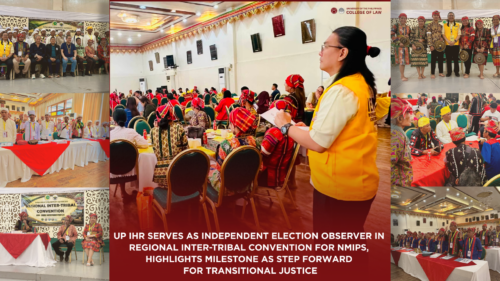
Ahead of the 1st Bangsamoro Autonomous Region in Muslim Mindanao (BARMM) Parliamentary Elections scheduled on 14 September 2026, Non-Moro Indigenous Peoples (NMIPs) convened the Regional Inter-Tribal Convention (RITC) on 24–25 August 2026 in Cotabato City to select their mandatory representatives to the BARMM Parliament.
In accordance with the customary laws of the Blaan, Dulangan Menubu, Erumanen ne Menuvu, Higaonon, Lambangian, and Tëduray Indigenous Peoples, the RITC allowed the respective communities to select their mandatory representatives, as guaranteed by the Bangsamoro Organic Law. The RITC also served as a mechanism for the NMIPs to decide whether to adopt a rotation arrangement that would allow all six communities to be represented across three separate election cycles.
Compared to the rest of the Bangsamoro, which decides its representatives through direct plurality of votes using the ballot, NMIPs chose their representatives through a selection process consistent with their Indigenous Political Structures (IPS), or the organizational and cultural leadership systems, institutions, relationships, patterns, and processes for decision-making and participation identified by the NMIP communities.
Serving as an Observer for the Independent Election Monitoring Center (IEMC) and the UP Law Center Institute of Human Rights (IHR) was Atty. Raymond Marvic C. Baguilat, Head Legal Officer and Project Lead of the Indigenous Peoples Law and Policy Program. The Commission on Elections (COMELEC) En Banc accredited Atty. Baguilat as an Independent Observer in recognition of his assistance to the COMELEC in the preparation of the Implementing Rules and Regulations for the Selection of NMIPs Representatives in the BARMM Parliament and the continued advocacy of both the IEMC and IHR to promote and protect the rights of Indigenous Peoples.
Chosen to serve as the NMIPs’ representatives in the BARMM Parliament are Leticio L. Datuwata of the Lambangian Indigenous People and Jo Genna M. Jover of the Tëduray Indigenous People. The participating communities also agreed that, in the next election cycles, the Erumanen ne Menuvu and Dulangan Menubu shall be represented, followed in the third cycle by the Higaonon and Blaan Indigenous Peoples.
Remarking on the productive outcome of the RITC, Atty. Baguilat who recently came from Cotabato City shared, “[T]he success of the Regional Inter-Tribal Convention for the selection of the Members of Parliament representing the Non Moro Indigenous Peoples should be celebrated as a step forward for transitional justice and as a symbol of peace. The continuous dialogue and consensus-building demonstrated that Indigenous mechanisms of representation can be at par with, if not better than, mainstream electoral processes.”
The success of the RITC is an optimistic preview of a future that provides genuine political representation to the Indigenous Peoples of Bangsamoro, who have historically been denied their right to self-determination and self-governance. This is only the first step towards a future where the NMIPs are able to participate in the political decision-making processes that affect their rights and chart their own destiny in accordance with their respective customary laws and practices.
In the past, the IHR has provided academic fora and legal opinions to enhance the Bangsamoro Indigenous Peoples Act (Bangsamoro Autonomy Act No. 64) and drafted its Implementing Rules and Regulations. It has also shared its studies through the grant provided by the Australian National University.
Atty. Baguilat aptly stated that “[T]he selection of the Members of Parliament representing the Non-Moro Indigenous Peoples is a crucial step toward the realization of their rights to self-determination and self-governance. The Blaan, Dulangan Menubu, Erumanen ne Menuvu, Higaonon, Lambangian, and Tëduray peacefully selected their representatives through their customary laws, without intervention from the dominant society. They also agreed to ensure that every community has an opportunity to be effectively represented by establishing a rotation agreement that will allow each community to directly participate in the representation process in succeeding election cycles. We commend the NMIPs for demonstrating to the rest of the country that peace, dialogue, patience, and consensus-building remain at the heart of their customary governance. We are grateful for the democratic space provided by the Bangsamoro government, the COMELEC, the BARMM Police Regional Office–Bangsamoro Autonomous Region (PRO BAR), the AFP, and our CSO partners, particularly the Institute of Autonomy and Governance (IAG). The RITC may not have proceeded as smoothly without their support.”






























 on the upper right corner to select a video.