
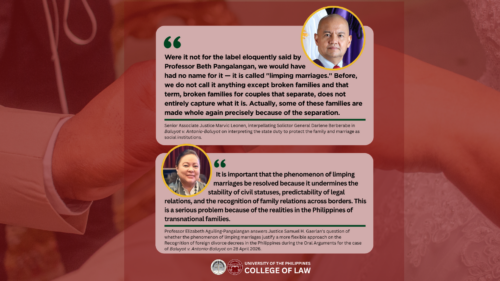
Professor Elizabeth H. Aguiling-Pangalangan, the Philippine Representative for Children’s Rights to the ASEAN Commission on the Promotion and Protection of the Rights of Women and Children (ACWC) and Head of the UP Institute of Human Rights(UP IHR) Child’s Rights Program, continued to serve as amicus curiae during the concluding oral arguments in Baluyot v. Antonio-Baluyot before the Supreme Court on 11 August 2026. The case presents a novel question of law of whether Philippine courts should recognize a foreign divorce decree obtained by two Filipino citizens, considering the absence of an absolute divorce law in the Philippines.
While interpellating Solicitor General Darlene Berberabe, Associate Justice Marvic M.V.F. Leonen noted that were it not for Professor Aguiling-Pangalangan’s illuminating discussion on “limping marriages,” we might lack a precise term for this situation in which marriages are already dissolved in one jurisdiction but still recognized in the Philippines. According to Justice Leonen, these “limping marriages” were previously called “broken families,” but he observed that this does not accurately capture the social and legal realities experienced by these families with separated couples.
The concept of “limping marriages,” as explained by Professor Aguiling-Pangalangan in earlier oral arguments, results in legal confusion for the families. It essentially places women and children in a legal limbo concerning their rights in issues of succession, inheritance, and custody due to the non-recognition of the foreign divorce in the Philippines. This is especially concerning given that the Philippines is home to transnational families.

































































 on the upper right corner to select a video.