
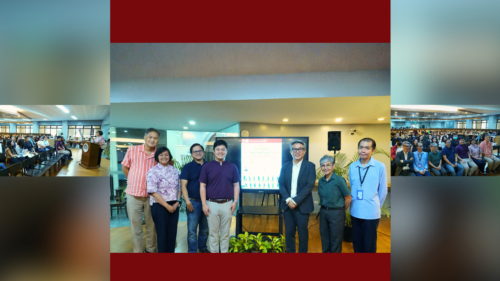
In partnership with the Office of the Associate Dean of the University of the Philippines College of Law (UP Law), the Workers and Employees Program (WEP) of the University of the Philippines Law Center (UPLC) launched the first WEP Kapihan sa Commons on 10 March 2026 at the Learning Commons, Malcolm Hall, UP Law Complex, UP Diliman, Quezon City. A total of 81 members of the UP Law Complex, mostly law students, were introduced to the concept of Just Transition (JT), its intersection with climate law and policy, and its impacts on the working conditions and rights of Filipino workers.
The activity opened with welcome remarks from UP Law Dean Gwen Grecia-De Vera.
Atty. Jayvy R. Gamboa, Senior Lecturer at the UP Law and a Faculty Intern of the WEP, then gave an introductory lecture on JT, climate law and policy, and legal systems.
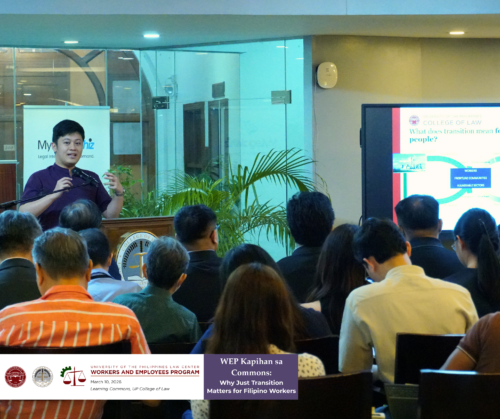
Atty. Gamboa explained the need for JT because of the climate crisis. He described JT as both a vision and a process of shifting from a high-carbon to a low-carbon economy negotiated among stakeholders affected by the transition. JT has two dimensions: (1) the transition dimension, which involves socio-technical changes across sectors such as energy, transportation, and agriculture; and (2) the justice dimension, which foregrounds social justice considerations. Both dimensions should be considered interdependently, Atty. Gamboa pointed out, since there can be no just transition if people are more oppressed than before. JT integrates procedural, distributional, restorative, and recognition justice, while also accounting for time constraints and place-based differences, especially in the Global South, where vulnerabilities are greater.
With respect to JT’s relation to legal systems, Atty. Gamboa explained the international sources of climate law and policy, including the United Nations Framework Convention on Climate Change and the Paris Agreement. He noted that the Philippines is currently crafting a national framework for how JT may be applied in the country. While there is no clear body of JT laws yet, the public may refer to the Constitution and existing statutes as bases for advancing JT in the Philippines.
Atty. Gamboa emphasized that domestic transitional laws and strategies must ensure a just transition through localized and contextualized approaches to address differentiated vulnerabilities. He discussed how businesses and governments have a wide discretion in facilitating green transitions, while workers have comparatively few safeguards. Thus, there is a need to strengthen labor organizations so that JT-related safeguards can be established at the workplace level.
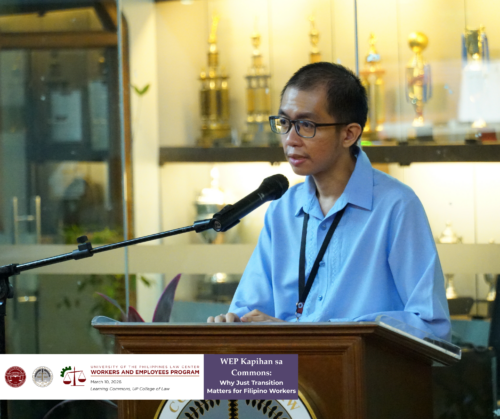
Mr. Julius H. Cainglet, Convenor of Workers for Just Transition, then presented the Filipino workers’ experiences and reflections in advocating for JT.
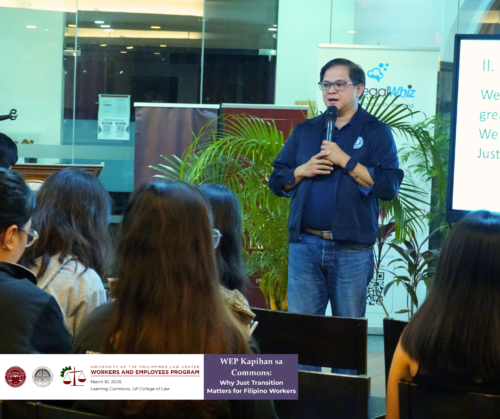
According to Mr. Cainglet, the Philippine labor movement advances JT by aligning with global climate goals like the Paris Agreement and by advocating for stronger commitments from the Philippines and the international community to establish worker-centered climate policies and social protection and hold the Global North accountable for its disproportionate contribution to pollution.
Mr. Cainglet highlighted how JT should be a people-centered process of co-creation, with workers actively involved. JT is not limited to economic and energy transition, but also extends to restructuring business models that provide decent work, social protection, and living wages for workers.
From a domestic perspective, Mr. Cainglet shared how switching from fossil fuels to other sources of energy remains a challenge in the Philippines, where many industries continue to depend on them. Beyond this, he highlighted the need to strengthen unions, provide social protection, especially in addressing heat stress experienced by workers in the construction and agriculture sectors, examine the technologies used in extracting mineral resources, and assess existing responses to flood-related loss and damage experienced by workers.
Mr. Cainglet introduced the 13-point Labor Agenda,[1] developed by different labor groups and addressed to the Philippine Government as a framework for achieving an inclusive, equitable, and just transition in the country.

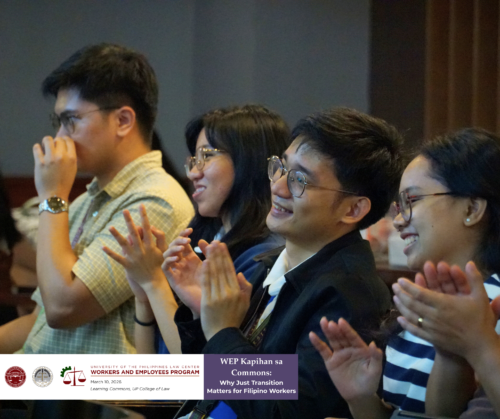
He urged the legal community to support this advocacy by strengthening labor rights frameworks, ensuring meaningful worker participation in policymaking, and helping design equitable, context-sensitive laws and institutions that genuinely protect workers and communities during the transition.
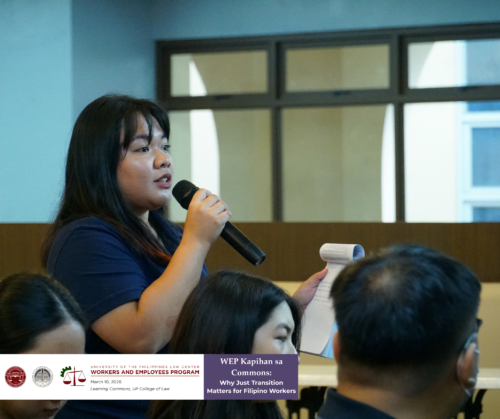
The Kapihan concluded with a moderated discussion, during which participants shared questions and reflections.
WEP looks forward to future Kapihan sessions where relevant, emerging, and timely labor-related topics are introduced and promoted among members of the UP Law Complex and the public.
# # #
[1] https://docs.google.com/document/d/1u7m6GMbdEhwOIJRPWjujaRx822AebBTB6GX7lLTv6NM/edit?tab=t.0











































































 on the upper right corner to select a video.