
UP IHR opens a multidisciplinary dialogue on the Legalization of
Medical Cannabis in the Philippines
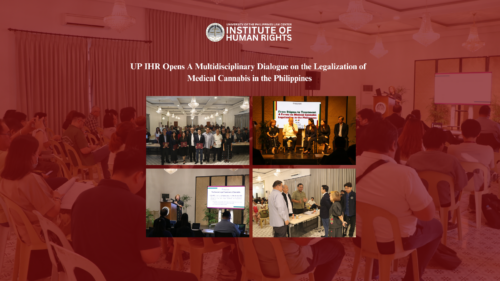
Against the backdrop of the Philippines’ deeply conservative and punitive approach to drug-related issues, the UP Law Center Institute of Human Rights (UP IHR) spearheaded a bold and timely conversation through “From Stigma to Treatment: A Forum on Medical Cannabis Legalization in the Philippines,” held on April 23, 2026.
The Forum brought together key stakeholders, including legal experts, healthcare professionals, policymakers, civil society organizations, and members of the academic community, to discuss the therapeutic and medical potential of cannabis, hear testimonies on its use for medical purposes, and examine the legal and policy considerations surrounding the possible regulation of cannabis for medical use in the country.
Prof. Gwen Grecia-De Vera, LL.M, Dean of the UP College of Law, opened the forum by situating the discussions on medical cannabis within the broader evolution of the Philippine’s drug policy framework and the growing recognition and integration of public health and human rights considerations. She also highlighted UP IHR’s efforts in advancing rights-based and evidence-informed approaches to drug policy reform, and how the Forum builds on UP IHR’s previous initiatives, this time by exploring the medical and regulatory dimensions of cannabis.
Atty. Glenda T. Litong, LL.M, MPSA, UP IHR’s Senior Law Reform Specialist and the Forum’s Project Lead detailed the current legal treatment of cannabis in the Philippines and the human rights framework underpinning calls for the legalization of medical cannabis. It was noted that while cannabis remains restricted under Republic Act 9165, recent findings from across the globe prove it has no inherent tendency to be abused. It was underscored how a human rights-based approach and public health-oriented approach to medical cannabis regulation, as espoused in both International Instruments such as the ICESCR and the Philippine Constitution, aligns with the State’s duty to protect vulnerable sectors through policies which give access to palliative care and medicine at affordable prices.
Dr. Peter Quilala, Board Member of the Philippine Society of Cannabinoid Medicine and Dr. Donnabel Trias-Cunanan, President of Cannahopefuls, challenged long standing medical stigmas on cannabis by presenting scientific and clinical evidence. Dr. Quilala underscored the role of cannabis in pain management, epilepsy treatment, and palliative care based on various scientific studies. On the other hand, Dr. Trias-Cunanan, shared current research on cannabinoids and their therapeutic benefits, likewise stressing the importance of public awareness, accessible healthcare, and destigmatizing medical cannabis.
Mr. Chuck S. Manansala, President of Masikhay Research, and Ms. Lea Fullon, Executive Director of Haraya Policy Center drew attention to the tensions between the rigidity of the current laws relating to medical cannabis, and the lived realities of families navigating the current, generalized policy on drugs to save their loved ones. Mr. Manansala shared the experiences of patients and families who have used medical cannabis in managing medical conditions like epilepsy. At the same time, Ms. Fullon voices out the heartbreak and experiences families and individuals who deem themselves as “accidental outlaws, [because of their] biological necessity”. Their talks underscored the urgent need for patient-centered reforms and decriminalization of the use of medical cannabis.
Hon. Brian Poe Llamanzares, current Representative from the FPJ Panday Bayanihan Partylist, discussed the current legislative proposals on medical cannabis, including the creation of a dedicated Philippine Medical Cannabis Authority. He emphasizes that future legislation must prioritize disclosure of beneficial ownership to prevent abuse and exploitation, while guaranteeing affordability for legitimate use responsiveness to the realities faced by Filipinos.
Atty. James Gregory A. Villasis, MHRD, University Researcher of UP IHR, moderated the open forum, wherein Forum’s attendees raised important questions for the Forum Speakers. On the concern regarding operational realities in domestic cultivation, the Panelists agreed that relying entirely on imported, foreign-branded pharmaceuticals keeps life-saving treatments out of reach for ordinary Filipino families, leaving them exposed to black-market risks. The open forum also provided an avenue to brainstorm possible entry points for medical cannabis such as through collaboration with the Philippine Institute Of Traditional And Alternative Health Care (PITAHC).
Atty. Daniel D. Lising, LL.M, MD, Officer-in-Charge of UP IHR, closed the programme by stressing the value of grounding future reforms in scientific evidence, human rights, and compassion, while encouraging continued engagement among advocates, legal practitioners, healthcare professionals, and policymakers in shaping responsive and humane drug policies.


































 on the upper right corner to select a video.