
UP Institute of Human Rights Marks Indigenous Peoples Month with Advocacy and Action
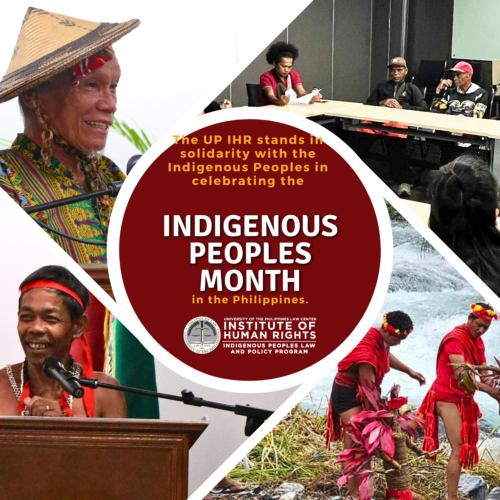
The University of the Philippines Law Center – Institute of Human Rights (UP IHR) and its Indigenous Peoples Law and Policy Program join the nation in commemorating Indigenous Peoples Month this October. The observance is rooted in Presidential Proclamation No. 1906 (2009), which underscores the Constitutional mandate to recognize and protect the rights of Indigenous Cultural Communities/Indigenous Peoples (ICCs/IPs) within the framework of national unity and development. This is further reinforced by Republic Act No. 8371, otherwise known as the Indigenous Peoples Rights Act (IPRA) of 1997. Additionally, Proclamation No. 486 designates October 29 of every year as National Indigenous Peoples Thanksgiving Day, giving due recognition to the vital role of indigenous communities in the country’s history and identity.
Guided by these mandates, the UP IHR continues to strengthen its work in advancing the rights of Indigenous peoples through research, education, and advocacy. Through the leadership of Atty. Raymond Marvic C. Baguilat, Lead Researcher of the Indigenous Peoples Law and Policy Program and Head Legal Officer of the UP IHR, has actively engaged the Institute in initiatives that provide platforms for dialogue and promote rights-based approaches to development.
In a series of speaking engagements and workshops from July to October 2025, Atty. Baguilat served in national and international forums. This month, Atty. Baguilat participated in the international conference “Tindig at Tinig: Navigating Indigenous Voices and Data for Human Rights and Sustainable Development,” which gathered Indigenous leaders, government representatives, academics, and advocates at the Asian Institute of Tourism, UP Diliman, held from October 15–17, 2025. Co-organized by Pangasinan Polytechnic College (PPC), Tebtebba Foundation Inc., and the Asian Institute of Tourism. Through open dialogue and shared experiences, the conference emphasized collaboration toward upholding Indigenous knowledge systems and ensuring their inclusion in policy and data governance frameworks.
Atty. Baguilat served as a panelist and highlighted the need to properly review the Fourth Philippine Human Rights Plan to align it with Indigenous priorities and policies. He reminded participants that genuine inclusion requires humility and openness from government institutions when listening to Indigenous voices. “Sovereignty resides in the people,” he stressed, urging public servants to serve with empathy and accountability. Atty. Baguilat underscored that Indigenous grievances are rooted in centuries of historical injustice, and addressing them sincerely is essential to realizing human rights and sustainable development goals.
During the open forum, Atty. Baguilat explained, “[A]lam ko naman na professional ang ating mga kawani ng gobyerno at di naman sana sila balat sibuyas. Sabi nga sa ating saligang batas, sovereignty resides in the people and all government authority emanates from them. Tandaan natin na sila ang pinagsisilbihan natin at may pinaghuhugutan sila dahil sa bawat matinong mga kawani ay meron din na mga umaabuso sa karapatan ng ating mga kapatid na Katutubo. Atin silang pakinggan at mayroong pinanggagalingan ang kanilang hinaing. (I know that our government personnel are professionals and, hopefully, not thin-skinned. As our Constitution says, sovereignty resides in the people, and all government authority emanates from them. We must be reminded that they are the ones we serve, and their grievances come from real experiences, especially since, alongside many good public servants, some have abused the rights of our Indigenous brothers and sisters. We should listen to them, for their concerns come from a rightful place.)”
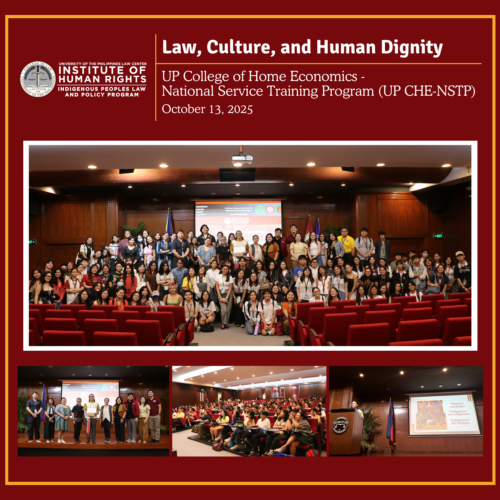
Atty. Baguilat also delivered a two-part lecture on law, culture, and human dignity before students of the UP College of Home Economics (UP CHE), in partnership with the UP CHE National Service Training Program, on October 13, 2025. He explained the core principles of human rights, examined the challenges of exercising these rights in the Philippine context, and reviewed both international and domestic legal frameworks for Indigenous peoples’ protection.
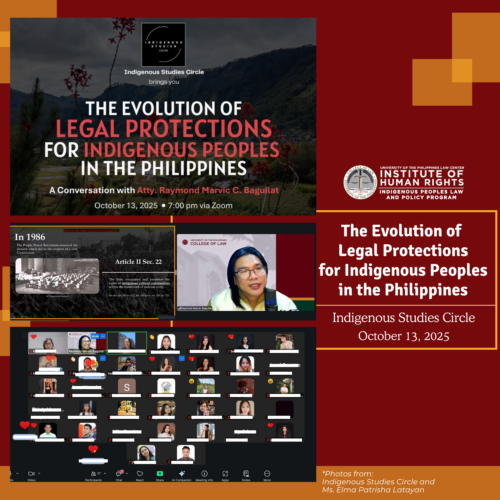
On the same day, in an online dialogue organized by the Indigenous Studies Circle (ISC), Atty. Baguilat traced the evolution of legal protections for Indigenous Peoples in the Philippines. He discussed how the law has shaped—and continues to shape—the struggle for recognition, justice, and the preservation of indigenous heritage and identity.
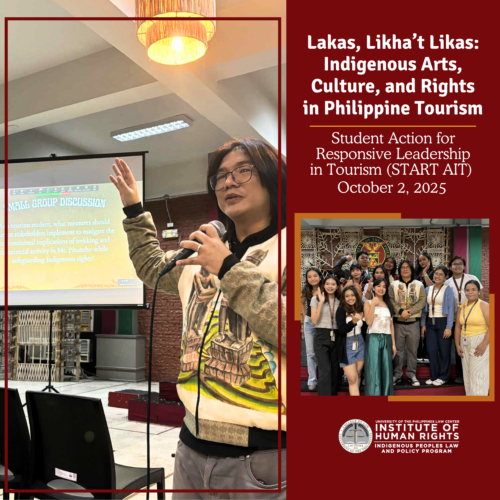
On October 2, 2025, Atty. Baguilat delivered the keynote address at Lakas, Likha’t Likas: Indigenous Arts, Culture, and Rights in Philippine Tourism, hosted by the Student Action for Responsive Leadership in Tourism (START AIT) at the UP Asian Institute of Tourism. He underscored that sustainable tourism must extend beyond environmental conservation to include cultural integrity and human rights. He emphasized that safeguarding indigenous culture is not about halting development but about changing the terms of engagement—moving from a model of exploitation to one of genuine partnership, guided by the principle of Free, Prior, and Informed Consent (FPIC).
On August 8, 2025, the UP IHR also organized A Forum on Transitional Justice and Peace in the Bangsamoro Autonomous Region in Muslim Mindanao (BARMM): Examining the Protection of the Rights of non-Moro Indigenous Peoples (NMIPs) and Marginalized Moro Peoples (MMPs) in the Region. The forum advanced research and advocacy to amplify the voices of Bangsamoro Indigenous peoples in pursuit of justice and inclusive governance, particularly as these communities continue to face structural discrimination, political exclusion, and violence.
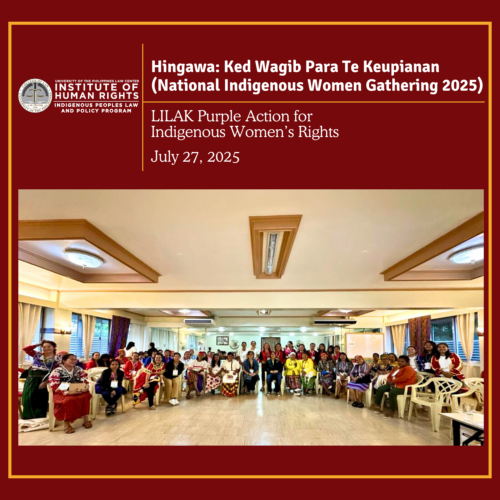
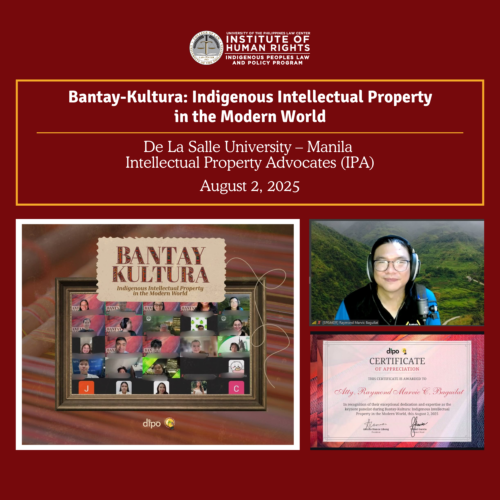
On July 27, 2025, the UP IHR participated in Hingawa: Ked Wagib Para Te Keupianan (National Indigenous Women Gathering 2025), where Indigenous women from over 20 communities across the country came together in a powerful convergence of voices, cultures, and visions for a more inclusive future. The gathering spotlighted the resilience and leadership of indigenous women as custodians of cultural heritage and agents of change. This was followed on August 2, 2025, by Bantay-Kultura: Indigenous Intellectual Property in the Modern World, organized by the De La Salle University – Manila Intellectual Property Advocates (IPA), where Atty. Baguilat served as the keynote speaker. The event addressed the urgent need to protect indigenous cultural heritage through intellectual property law, exploring how traditional knowledge and cultural expressions are recognized, or at times misused, in contemporary legal and commercial contexts.
On July 14, 2025, Atty. Baguilat also served as a resource speaker at the Katungod Conference 2025 in Cagayan de Oro City. Co-organized by Mindanao Climate Justice and the Social Action Center of the Archdiocese of Cagayan de Oro, the conference, whose theme focused on upholding Indigenous Peoples’ dignity and defending environmental human rights defenders, brought together diverse sectors to advocate for justice and solidarity. In his address, Atty. Baguilat underscored the right to a balanced and healthful ecology as both a legal and moral duty, emphasizing its significance for Indigenous Peoples and environmental defenders. He also highlighted the use of legal mechanisms such as the Writ of Kalikasan and SLAPP defense provisions to confront the growing threats of environmental degradation, climate impacts, and the criminalization of land and rights defenders.
In the coming weeks, the IPLPP will be submitting its input to the UN Working Group on Business and Human Rights on the thematic focus of Indigenous Peoples’ Free, Prior, and Informed Consent (FPIC) within the framework of Business and Human Rights. This initiative forms part of the Program’s ongoing advocacy to ensure that business activities affecting Indigenous territories adhere to human rights standards, uphold Indigenous self-determination, and promote accountability in corporate practices. Through this submission, the program contributes to the global dialogue on responsible business conduct and the protection of Indigenous Peoples’ rights in development and investment contexts.
Since its establishment in 2022, the Indigenous Peoples Law and Policy Program (IPLPP) has engaged with more than 160 Indigenous communities nationwide and partnered with numerous civil society organizations. Atty. Baguilat has also participated in over 50 trainings, forums, workshops, and conferences, both locally and abroad, where he listened to Indigenous concerns, amplified their voices, and served as a trusted resource person and instructor for the protection of Indigenous Peoples’ rights.
As the nation observes Indigenous Peoples Month, the UP IHR stands in unwavering solidarity with Indigenous communities who continue to face displacement, marginalization, and violence. The Institute reaffirms that Indigenous Peoples are not merely stakeholders but rights-holders. Their voices, struggles, and aspirations must be at the heart of building an inclusive, just, and sustainable future.



























































 on the upper right corner to select a video.