
What will the International Court of Justice decide in The Gambia v. Myanmar?

What will the International Court of Justice decide in The Gambia v. Myanmar?
Application of the Convention on the Prevention
and Punishment of the Crime of Genocide
Prepared by: John Paolo Cabrera
With the assistance of: Jose Emmanuel Junio, Chloe Cheyne Wu, Asst. Prof. Michael T. Tiu, Jr.
The International Court of Justice is set to deliver its judgment in the case entitled Application of the Convention on the Prevention and Punishment of the Crime of Genocide (The Gambia v. Myanmar) on November 19, 2026. The case involves allegations of committing genocide by Myanmar in relation to the Rohingya people, a Muslim minority in the primarily Buddhist country. The case will decide questions relating to the Genocide Convention.
The Genocide Convention
The Convention on the Prevention and Punishment of the Crime of Genocide (the Convention) was adopted on December 9, 1948. Article II of the Convention defines Genocide as an act committed with intent to destroy, in whole or in part, a national, ethnical, racial, or religious group as such. The acts within the purview of genocide are:
(a) Killing members of the group;
(b) Causing serious bodily or mental harm to members of the group;
(c) Deliberately inflicting on the group conditions of life calculated to bring about its physical destruction in whole or in part;
(d) Imposing measures intended to prevent births within the group;
(e) Forcibly transferring children of the group to another group.
The Convention sets out several obligations for State Parties. Article V prescribes the obligation to provide effective penalties for the commission of genocide, conspiracy to commit it, directing and public incitement to commit it, attempts to commit, and complicity. Further, Article VI mandates that such acts be punished by either a tribunal in the State where the act was committed or an international tribunal with jurisdiction. Lastly, Article VIII empowers State Parties to call upon competent UN organs to take appropriate action to prevent and suppress such acts.
Elements
For an act to be punished under the Convention, two elements must concur. The first element requires the commission of any of enumerated acts or the actus reus.[1] The second element requires a “specific intent to destroy, in whole or in part, a national, ethnic, racial or religious group as such,”[2] with the group also being known as a protected group.[3]
According to Cassese, there is a debate about whether a general genocidal policy is also required for the act to be punished under the Convention.[4] One view advocates that a policy is not an element of genocide per se; however, it also recognizes that it is extremely difficult for one to commit genocide without having access to the powers of a State.[5] In other words, a genocidal state policy is not a legal element of genocide; however, for practical purposes, it is improbable that genocide may be committed without it. The other view posits that a genocidal state policy is required. This view posits that genocide “may never consist of isolated acts directed against a specific protected group or members of the group: such acts, to qualify as genocide, need to be supported by or be predicated on a general action pursued by a government or a de facto state-like authority.”[6]
Specific Intent in Genocide
The specific intent, or dolus specialis, requirement in genocide has been described as the “essence of genocide.”[7] According to Schabas, without proof of such specific intent to destroy, in whole or in part, a national, ethnical, racial, or religious group, the act may not be punished as genocide.[8] An application of this principle would be, for example, if the act of killing members of a protected group was proven, but no intent to destroy the protected group was shown, then the same cannot be punished under Article II of the Genocide Convention.
This specific intent is usually proven through material acts from which the same could be deduced, and that such proof could be in the form of speeches or declarations, state policies, the context and scale of the acts, the propagation of hatred against the protected group or the perpetration of discriminatory acts against them in particular, and other similar acts.[9]
Another mental element in genocide, as opposed to intent to destroy, is general intent.[10] The basis for general intent can be found in Article 30 (1) of the Rome Statute, which states that “unless otherwise provided, a person shall be criminally responsible and liable for punishment for a crime within the jurisdiction of the Court only if the material elements are committed with intent and knowledge.” Thus, some authors have described general intent as “encompassing a volitional (intent) and/or a cognitive or intellectual (knowledge) element.”[11] This is in contrast with the intent to destroy, which “constitutes an additional subjective requirement that complements the general intent and goes beyond the objective elements of the offence definition.”[12] Though there is debate about a concrete definition of intent to destroy, it has been defined as “a special or specific intent which, in essence, expresses the volitional element in its most intensive form and is purpose-based.”[13]
It is against this legal backdrop that the case against Myanmar is viewed.
The case against Myanmar
On 09 October 2016, in the town of Maungdaw in the Rakhine State of Myanmar, a series of attacks on police outposts led to the death of nine police officers, with the Myanmar police alleging that the unprovoked attack was caused by a militant group, the Rohingya Solidarity Organization (RSO), which was claimed by the authorities as part of the Rohingya minority group of the region – a group of people rejected by the government of Myanmar of citizenship.[14]
As a response, the Myanmar government initiated “clearance operations” in the towns of Maungdaw and Yathedaung, which consisted of army raids on Rohingya Muslim villages in the Rakhine State.[15] The said operations caused deaths, and the Myanmar government forces were also alleged to have employed a “scorched-earth” approach by burning Rohingya Muslims’ villages.[16] Allegations of rape and sexual assault being committed during such “clearance operations” were also raised, but were denied by Presidential spokesperson Zaw Htay in an interview.[17]
As a response, in March 2017, the United Nations Human Rights Council (UNHRC) established the Independent International Fact-Finding Mission on Myanmar (IIFFMM) to investigate and to determine the facts of the alleged human rights violations committed by the armed forces of Myanmar.[18]
At the 73rd Session of the United Nations General Assembly (UNGA) on 25 September, 2018, Gambia President Adama Barrow issued a statement, declaring that, as an upcoming Chair of the 15th Islamic Summit of the Organization of Islamic Cooperation (OIC) in 2024, The Gambia will “champion an accountability mechanism that would ensure that perpetrators of the terrible crimes against the Rohingya Muslims are brought to book.”[19]
On 08 August, 2019, prior to the conclusion of IIFFMM’s mandate, the Mission delivered before the UNGA the report of the independent international fact-finding mission on Myanmar in which the Mission welcomed contributions from different states and parties—in particular Bangladesh, The Gambia, and the OIC—and their plans to pursue a case against Myanmar to be filed before the International Court of Justice under the Convention on the Prevention and Punishment of the Crime of Genocide.[20]
In a Note Verbale transmitted by the Permanent Mission of The Gambia to the United Nations to Myanmar’s Permanent Mission on 11 October 2014, The Gambia’s representative expressed its concerns over the findings of the IIFFMM and the subsequent rejection of such report by Myanmar.[21]
Later on, The Gambia’s Minister of Justice Abubacarr Marie Tambadou announced on October 18, 2019, that The Gambia will take Myanmar to the International Court of Justice for the alleged acts of genocide committed by Myanmar’s armed forces against Rohingya Muslims.[22]
Eventually, on 11 November, 2019, the Republic of The Gambia instituted proceedings against the Republic of Myanmar before the ICJ for the alleged violations of the Convention on the Prevention and Punishment of the Crime of Genocide against the Rohingya group by means of “mass murder, rape and other forms of sexual violence, as well as the systematic destruction by fire of their villages, often with inhabitants locked inside burning houses” under the guise of ‘clearance operations’.[23]
The Submission of The Gambia
Before the ICJ, The Gambia submitted its memorial containing its arguments against Myanmar. The said arguments in the memorial are summarized below.
The Gambia alleges that, as defined in Article 2 of the Genocide Convention, Myanmar committed genocide through the following acts, committed with specific intent to destroy a protected group:[24]
First, The Gambia alleged that Myanmar committed the act of killing members of the Rohingya group. The Gambia alleged that this act was accomplished via Myanmar’s clearance operations, citing that though the exact number of deaths by virtue of such killings remains unresolved, the existence of the clearance operations, which included large-scale massacres, was confirmed by interviews and other information obtained in separate villages by the UN Fact-finding mission.[25]
Second, The Gambia alleged that Myanmar is guilty of causing serious bodily or mental harm to members of the Rohingya group. The Gambia asserts that those who did survive the clearance operations experience mutilation and serious mental harm even after the fact, such as Rohingya girls who were raped and subsequently had their sexual organs mutilated.[26]
Third, The Gambia alleged that Myanmar is guilty of deliberately inflicting on the Rohingya group conditions of life calculated to bring about its destruction in whole or in part. Gambia alleges that this act was committed when Myanmar imposed “‘movement restrictions’, ‘restrictions on access to food and livelihood’, ‘arbitrary and cumbersome procedures to access hospitals and health facilities’, ‘segregation from other communities’ and the ‘regular blocking of humanitarian assistance in Rakhine State.’ The Gambia also points to the conclusion of the UN Fact-Finding Mission that the “Tatmadaw carried out a widespread and systematic programme of ‘extensive burning that destroyed Rohingya villages, followed by the bulldozing of lands to an unrecognizable state in many locations’, with the result that Rohingya ‘villages’ and ‘communities’, as they ‘once existed in the three townships of northern Rakhine, have been erased forever.’”[27]
Fourth, The Gambia alleged that Myanmar is guilty of imposing measures intended to prevent births within the Rohingya group. In substantiating this claim, The Gambia pointed to the finding of the UN Fact-Finding Body that the government of Myanmar propagated a narrative that the Rohingya people, by virtue of their higher birth rate, would soon outnumber the other ethnic groups.[28] This, in turn, led to the widespread rape of childbearing-age women in the Rakhine State, as such women had a lower propensity for procreation by virtue of the social stigma they would then face.[29]
As for the element of genocidal intent, The Gambia points to several circumstances that served as evidence of the same on the part of the government of Myanmar.
First, Gambia points to several discriminatory laws and policies enacted by Myanmar. One such law is the 1982 Citizenship Law, which effectively denationalized the Rohingya people. This law, taken together with “General Ne Win’s statement that ‘the Rohingya were stripped of their citizenship because they are a race of people who cannot be trusted fully’ and that ‘racially, only pure-blooded nationals will be called citizens,” evidenced genocidal intent.[30] According to Gambia, Myanmar also forcibly segregated the Rohingya people in “internment camps, ghettos and isolated villages.”[31]
To bolster its claims, The Gambia cited precedent to show that Myanmar’s activities that prevented the Rohingya from procreating were indicative of genocidal intent. Among these is the UN Secretary-General’s Special Advisor on the Prevention of Genocide’s opinion that the “‘[d]evelopment of policies or measures that seriously affect the reproductive rights of women’ is indicative of genocidal intent.”[32] Another is the International Criminal Tribunal for Rwanda’s holding that “Forced birth control and restrictions on marriages can be seen as measures ‘intended to prevent births within the group’”[33] Lastly, it cited Croatia v. Serbia, a case decided by the ICJ, where it was held that “intent to destroy the group physically, in whole or in part” can manifest itself in measures that “have consequences for the group’s capacity to renew itself, and hence to ensure its long-term survival.”[34] According to The Gambia, the aforementioned precedent applied to the fact that Myanmar enacted laws “restricting marriages, imposing birth control measures and refusing to register or acknowledge Rohingya births,” and the fact that the Rakhine State Spokesperson said that the rationale for said measures is to control their population, lends credence to the existence of genocidal intent.[35]
The Gambia also cites hate speech propagated by Myanmar as evidence of genocidal intent. It asserts that the utterances of Myanmar government officials and leaders and state publications, as concluded by the UN Fact-Finding Mission, showed that the government encouraged hate speech and propagated a racist ideology against the Rohingya people, stoking fear that they would take over Myanmar from the Buddhist population and Islamize it.[36] The Gambia related this fact to the opinions of scholars that hate speech targeting a specific group can show genocidal intent, with an example being how the Nazis propagated hate speech against jews before the holocaust.[37]
Another circumstance which The Gambia alleges evidence of genocidal intent is the extreme brutality of the acts perpetrated by Myanmar. Gambia cites Croatia v Serbia, where the court stated that “genocidal intent can be inferred from ‘the scale and allegedly systematic nature of the attacks, the fact that those attacks are said to have caused casualties and damage far in excess of what was justified by military necessity, the specific targeting of [members of the protected group] and the nature, extent and degree of the injuries caused to the [protected] population.’”[38] In its memorial, The Gambia asserted that the clearance operations were conducted with extreme brutality, evidenced by the use of torture, mutilation, dismemberment, mass executions, systematic burning of homes, and the targeting of vulnerable groups such as pregnant women, infants, and the elderly.[39]
The Gambia also cites the sexual violence against the Rohingya people as evidence of genocidal intent. The Gambia cites The Prosecutor v. Jean-Paul Akayesu, which held that “sexual violence ‘forms an integral part of the process of destruction’ of a group because of the physical and psychological harm it inflicts on women, and the far-reaching consequences on their families and communities,” to substantiate that the rapes and gang rapes perpetrated against Rohingya women in a widespread manner show the existence of genocidal intent.[40]
The Gambia also alleges that the planned nature of the attacks is evidence of genocidal intent. The Gambia cites the systematic and coordinated nature of the killings in the clearance operations. The Gambia asserts that although there is no official record of the plan, the existence of a consistent modus operandi across all of the attacks shows that they are concerted in nature.[41] Thus, The Gambia concludes that “the clearance operations were carried out in a highly organized manner pursuant to a coordinated military plan. The Tatmadaw operates under a rigid and tightly controlled command structure that is entirely removed from civilian oversight. Operations are directed from above by the supreme military commander, the Commander-in-Chief, and obedience is strictly enforced.”[42]
Lastly, The Gambia cites the impunity that Myanmar afforded to its soldiers as evidence of genocidal intent. The Gambia again cites The Prosecutor v. Jean-Paul Akayesu, where it was held that “the failure ‘to take the necessary or reasonable measures to prevent such acts or punish the perpetrators [of genocide]’” is evidence of genocidal intent. In applying the precedent, The Gambia pointed out that the UN Fact-Finding failed to “investigate and prosecute gross violations of international human rights law and serious violations of international humanitarian law, both as they were occurring and after they occurred.”[43] The Gambia thus asserted that the Myanmar government’s position was to deny such violations and to propagate a message to its soldiers that they would be able to commit such acts with impunity.[44]
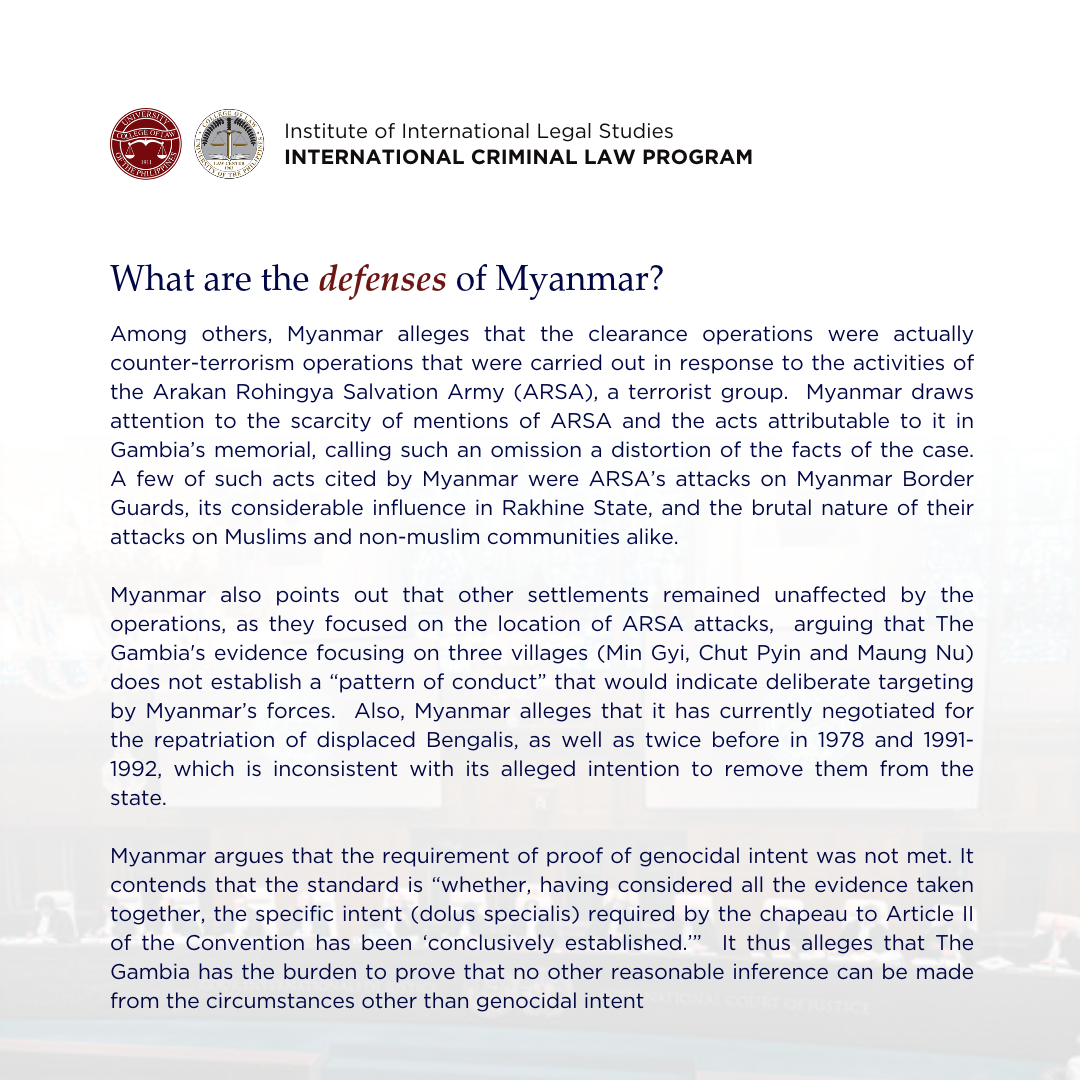
The Position of Myanmar
Myanmar then submitted its own counter-memorial denying the allegations of genocide against it.[45]
First, Myanmar alleges that the clearance operations were actually counter-terrorism operations which were carried out in response to the activities of the Arakan Rohingya Salvation Army (ARSA), a terrorist group.[46] Myanmar draws attention to the scarcity of mentions of ARSA and the acts attributable to it in Gambia’s memorial, calling such an omission a distortion of the facts of the case.[47] A few of such acts cited by Myanmar were ARSA’s attacks on Myanmar Border Guards, its considerable influence in Rakhine State, and the brutal nature of their attacks on Muslims and non-muslim communities alike.[48] Myanmar also points out that other settlements remained unaffected by the operations, as they focused on the location of ARSA attacks, arguing that The Gambia’s evidence focusing on three villages (Min Gyi, Chut Pyin and Maung Nu) does not establish a “pattern of conduct” that would indicate deliberate targeting by Myanmar’s forces.[49] Also, Myanmar alleges that it has currently negotiated for the repatriation of displaced Bengalis, as well as twice before in 1978 and 1991-1992, which is inconsistent with its alleged intention to remove them from the state.[50]
Second, Myanmar alleges that there was a lack of proof of the actus reus of Genocide. It contends that The Gambia has not proven, with the evidentiary levels required, that the acts committed during the operations are any of the prohibited acts under Art. II (a) to (d) of the Genocide Convention. Myanmar rejects The Gambia’s claim that the Bengali Muslims in northern Rakhine State are an “ethnic” group, a “religious” group, and a “racial” group under Art. II of the Convention and that the evidence to support these claims is insufficient.[51] It also rejects The Gambia’s suggestion of the distinct protected group status of the “Rohingya” based on the UN High Commissioner for Refugees and the FFM’s opinion and affirms the requirement of the burden of proof falling on The Gambia, which it has failed to provide.[52] Myanmar then points out that the term “killing” in Article II (a) does not extend to civilian casualties during counter-terrorism operations as well as “casualties of armed terrorists.”[53] Also, it cites that there is a lack of primary evidence and sufficient proof to determine that such killings would contribute to the destruction of the group, physically or biologically.[54] It then alleges that there is a lack of evidence distinguishing the actual number of innocent civilian casualties deliberately targeted by Myanmar, ARSA supporters, ARSA combatants, and collateral damage from the operations.[55]
Lastly, Myanmar argues that the requirement of proof of genocidal intent was not met. It contends that the standard is “whether, having considered all the evidence taken together, the specific intent (dolus specialis) required by the chapeau to Article II of the Convention has been ‘conclusively established.’”[56] It thus alleges that The Gambia has the burden to prove that no other reasonable inference can be made from the circumstances other than genocidal intent. From this premise, Myanmar points to the fact that there was no direct evidence to show genocidal intent,[57] and that such an intent could not be drawn from the circumstances, as it reemphasizes that Myanmar merely conducted counter-terrorism operations as a response to ARSA activities.[58] Myanmar thus pointed out that deliberate targeting of large numbers of civilians would not, by itself, establish genocide; based on the Bosnia Genocide case,[59] that the repatriation arrangements with Bangladesh are inconsistent with the intention to remove or destroy the population,[60] and that The Gambia’s argument of alleged “discriminatory law and policies” and alleged official and officially sanctioned hate speech is not enough to prove that discriminatory intent, if any, is equivalent to “genocidal intent.”[61]
The Philippines’s engagement with the issue
In 2023, a group of victims of the conflict in Myanmar filed a complaint against Myanmar military officials with the Philippine Department of Justice. The complaint relied on RA 9851 to assert the Philippines’ jurisdiction over the case.[62]
The complaint argued that Section 17 of RA 9851 “does not preclude the investigation and prosecution of international crimes whose perpetrators are not as of yet found on Philippine soil, subject to considerations of reverse complementarity and/or ‘the interest of justice.”[63] Using the doctrine of necessary implication and the reddondo singular singulis rule, the complaint asserted that Section 17(b) should be construed to mean that the Philippine State shall exercise jurisdiction over persons accused of the crimes defined therein regardless of the location of the crime and the citizenship of the accused.[64] It asserts that the exception under said section is only that such accused who have already been tried in other countries will no longer be prosecuted in the Philippines and that “Section 17(b) should not be read as restricting investigations or prosecutions of foreign nationals suspected or accused of war crimes only to those who are present in the Philippines.”[65] A contrary interpretation, it asserts, would go against the jus cogens obligations recognized by the Philippines and the policy sought to be advanced by law.[66] Thus, the complainants contend that, since Section 17 only uses the word “accused” and not “suspect,” the DOJ may begin a preliminary investigation of the accused even if they are not yet physically present in the Philippines.[67]
However, the Department of Justice is still to act on the complaint in 2026, prompting the complainants to file a petition for mandamus seeking to order a preliminary investigation into the alleged war crimes with the Philippine Court of Appeals.[68]
Conclusion
Forged in the aftermath of World War II, the Genocide Convention stands as a decisive global commitment to prohibit the grave crime of genocide. As the world watches the unfolding situation in Myanmar, the International Court of Justice’s impending ruling promises to be a pivotal benchmark—one that will not only shape international legal scholarship but also carry great weight for those who are supposed to benefit from the existence of the Convention—the people who are currently living through genocide.
[1] William A. Schabas, The mental element or mens rea of genocide, in Genocide in International Law: The Crime of Crimes. Cambridge: Cambridge University Press 241, 261 (2009).
[2] Florian Jeßberger, The Definition and the Elements of the Crime of Genocide, in The UN Genocide Convention: A Commentary 87, 89 (Paoloa Gaeta ed., 2009).
[3] See, Schabas, supra note 1.
[4] Antonio Cassese, Is Genocidal Policy a Requirement for the Crime of Genocide, in The UN Genocide Convention: A Commentary 128, 129-131 (Paoloa Gaeta ed., 2009).
[5] Id.
[6] Id.
[7] Jeßberger supra note 2 at 93, Schabas supra note 1 at 257.
[8] Schabas supra note 1 at 257.
[9] Id. at 264.
[10] Kai Ambos, What does ‘intent to destroy’ in genocide mean?, 91 Int’l Rev. of the Red Cross 876, 834 (2009).
[11] Id.
[12] Id. at 835.
[13] Id. at 837.
[14] Myanmar policemen killed in Rakhine border attack, BBC (Oct. 09, 2016), https://www.bbc.com/news/world-asia-37601928.
[15] Joshua Berlinger, et al., ‘Shoot first, ask questions later’: Violence intensifies in Rakhine State, CNN (Nov. 15, 2016), https://edition.cnn.com/2016/11/15/asia/myanmar-rakhine-state-unrest/.
[16] Id.
[17] James Griffiths, Is The Lady listening? Aung San Suu Kyi accused of ignoring Myanmar’s Muslims, CNN. 17, 2016), https://edition.cnn.com/2016/11/17/asia/myanmar-rohingya-aung-san-suu-kyi/.
[18] U.N. HRC, Independent International Fact-Finding Mission on Myanmar, Off. U.N. High Comm’r for Hum. Rts. (last visited Nov. 15, 2026), https://www.ohchr.org/en/hr-bodies/hrc/myanmar-ffm/index.
[19] The State House of The Gambia, Statement by H.E. Mr. Adama Barrow, President of the Republic of The Gambia at the General Debate of the 73rd Session of the United Nations General Assembly (2018), https://gadebate.un.org/sites/default/files/gastatements/73/gm_en.pdf.
[20] Rep. of the Ind. Int’l Fact-Finding Mission on Myanmar, at 17, U.N. Doc. A/HRC/42/50 (2019).
[21] Thomas Van Poecke, et al., The Gambia’s gamble, and how jurisdictional limits may keep the ICJ from ruling on Myanmar’s alleged genocide against Rohingya, EJIL: Talk! (Nov. 21, 2019), https://www.ejiltalk.org/the-gambias-gamble-and-how-jurisdictional-limits-may-keep-the-icj-from-ruling-on-myanmars-alleged-genocide-against-rohingya/.
[22] Gambia to file case against Myanmar, The Business Standard (Oct. 20, 2019), https://www.tbsnews.net/bangladesh/gambia-file-case-against-myanmar.
[23] International Court of Justice Information Department, The Republic of The Gambia institutes proceedings against the Republic of the Union of Myanmar and asks the Court to indicate provisional measures, ICJ, Nov. 11, 2019.
[24] Memorial of the The Gambia, Application of the Convention on the Prevention and Punishment of the Crime of Genocide, (Gam. v. Myan.) (Oct. 23, 2020).
[25] Id. at ¶¶12.1- 12.2.
[26] Id. at ¶¶ 12.5- 12.13.
[27] Id. at ¶¶ 12.15 – 12.16.
[28] Id. at ¶¶ 12.19 -12.20.
[29] Id. at ¶¶ 12.22 – 12.24.
[30] Id at ¶ 12.32.
[31] Id. at ¶ 12.35.
[32] Id. at ¶ 12.38.
[33] Id.
[34] Id. at ¶ 12.38.
[35] Id. at ¶ 12.39.
[36] Id. at ¶ 12.43 – 12.48.
[37] Id. at ¶ 12.46.
[38] Id. at ¶ 12.54.
[39] Id. at ¶ 12.57.
[40] Id. at ¶ 12.68.
[41] Id. at ¶ 12.79 – 12.82.
[42] Id. at ¶ 12.85.
[43] Id. at ¶ 12.92.
[44] Id.
[45] Counter-Memorial of the Republic of the Union of Myanmar, Application of the Convention on the Prevention and Punishment of the Crime of Genocide, (Gam. v. Myan.) (Aug. 24, 2023).
[46] Id. at ¶ 3.1.
[47] Id. at ¶ 3.5.
[48] Id. at ¶ 3.6.
[49] Id. at ¶ 1.15, 16.23 – 16.24.
[50] Id. at ¶ 16.27-16.28.
[51] Id. at ¶ 13.1 – 13.2.
[52] Id at ¶ 13.29.
[53] Id. at ¶ 13.38 – 13.39.
[54] Id.
[55] Id. at ¶ 1.19, 16.25, 16.29.
[56] Id. at ¶ 13.71.
[57] Id. at ¶ 13.73.
[58] Id. at ¶ 13.210.
[59] Id. at ¶ 16.29 – 16.30.
[60] Id. at ¶ 16.26 – 16.28.
[61] Id. at ¶ 10.8.
[62] Myanmar Accountability Project, Media Copy of Chin State War Cromes Complaint (2023), https://the-world-is-watching.org/wp-content/uploads/2023/10/Media-Copy-Chin_State_War_Crimes_Complaint_24.10.2023.pdf.
[63] Id. ¶ 69.
[64] Id. ¶ 116.
[65] Id. ¶ 132.
[66] Id. ¶ 133.
[67] Id. ¶ 1141.
[68] Ian Laqui, Myanmar nationals ask Philippines’ appeals court to act on stalled war crimes case, Phil. Star, Nov. 18, 2026.


































































 on the upper right corner to select a video.