
Election Issues of Workers, Freedom of Association, Special Groups of Workers the Focus of WEP 2025 Round Table Discussions
The University of the Philippines Law Center (UPLC) Workers and Employees Program held three more sets of online round table discussions (RTDs) with labor unions, federations, labor and labor-related non-government organizations, and individual workers. These followed the first RTD on Security of Tenure held in February 2025, and the onsite WEP-Federation of Free Workers (FFW)-National Anti-Poverty Commission Formal Labor and Migrant Workers Sectoral Council (NAPC-FLMWSC) Workers’ Forum: Talakayan hinggil sa Security of Tenure bills, Freedom of Association bills, Living Wages bills, at ilang amendments sa Labor Code held on 1 August 2025.
Setting Labor Legislative Agenda for the 20th Congress
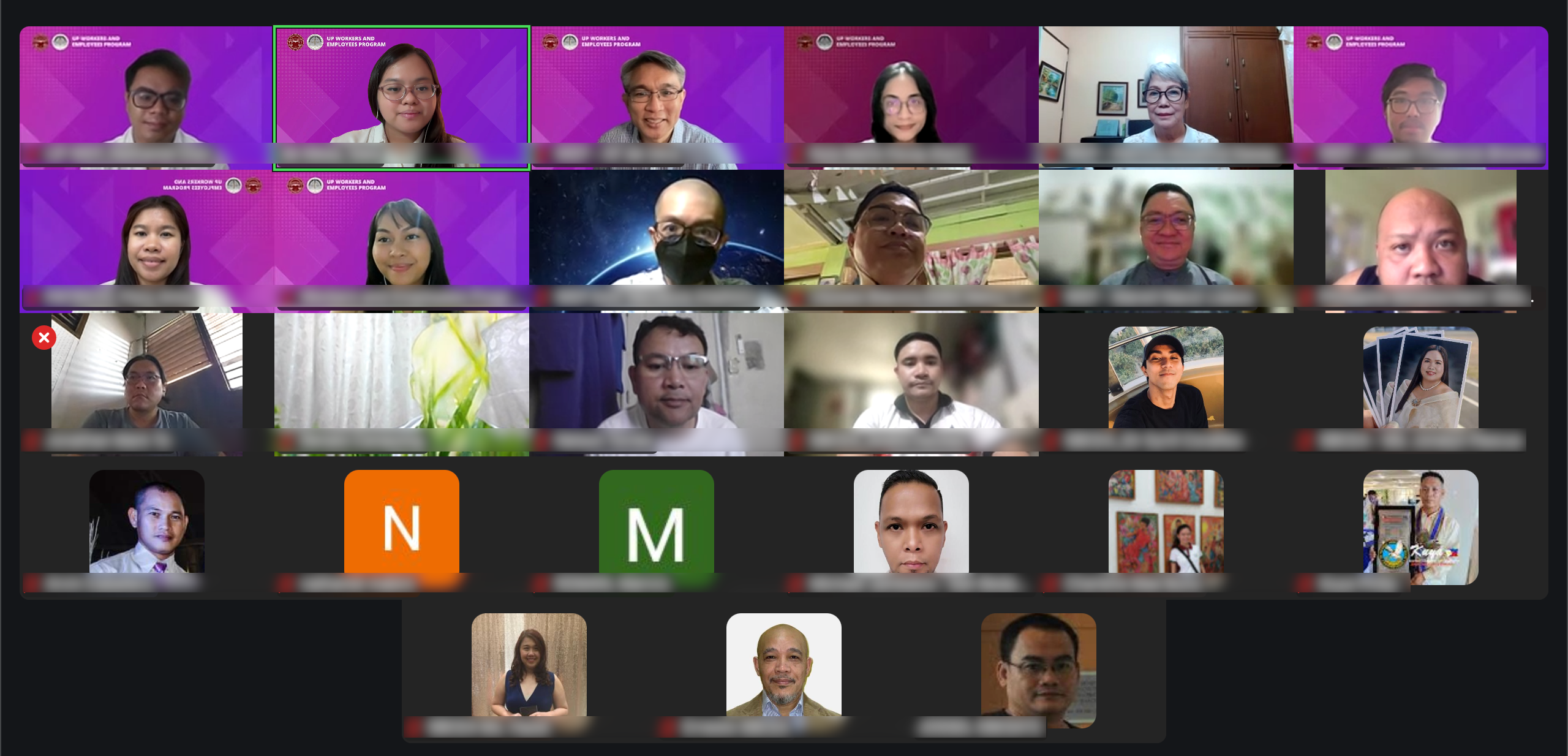
Held on 3 May 2025, a few days before the 12 May 2025 national and local elections, the RTD had two objectives:
- To discuss workers’ concerns that should be the basis when voting for legislators; and
- To encourage workers to consider the UPLC Proposed Revised Labor Code in voting for legislators, and to build support for its passage in the incoming 20th Congress.
This RTD continued WEP efforts on the Revised Code in 2023 and 2024.
A total of 19 participants from 8 labor organizations took part and raised the following issues:
- Remove the power of the Secretary of the Department of Labor and Employment (DOLE) on Assumption of Jurisdiction to stop strikes
- Pass guidelines or standards for addressing workplace violence or harassment by customers or outsiders
- Prohibit discrimination against union members in job promotions
- Set clear timeframes within which government agencies must respond to reports of labor law violations
- Protect whistleblowers reporting violations of the Safe Spaces Act
- Involve the labor sector in integrating labor rights in the curriculum of educational institutions
- Increase salaries and benefits even without corresponding tuition fee increases
- Mandate the presence of a union in every employer or workplace
- Ensure that DOLE issuances prevail over sector-specific issuances that are prejudicial to workers (e.g. longer probationary periods for teachers)
- Increase information dissemination among workers on labor rights
- Add the Labor Code as a core subject in the college curriculum
Participants expressed their intent to support the UPLC Proposed Revised Labor Code and suggested the following advocacy strategies:
- Make the proposed law the “flavor of the month”
- Utilize social media and mainstream media
- Release statements of support and advocacy posters
- Vote for politicians who will support the revisions
- Write to legislators to emphasize the importance of revising labor laws
- Join committee hearings or legislative forums and coordinate with legislators
- Launch signature campaigns
Freedom of Association Bill
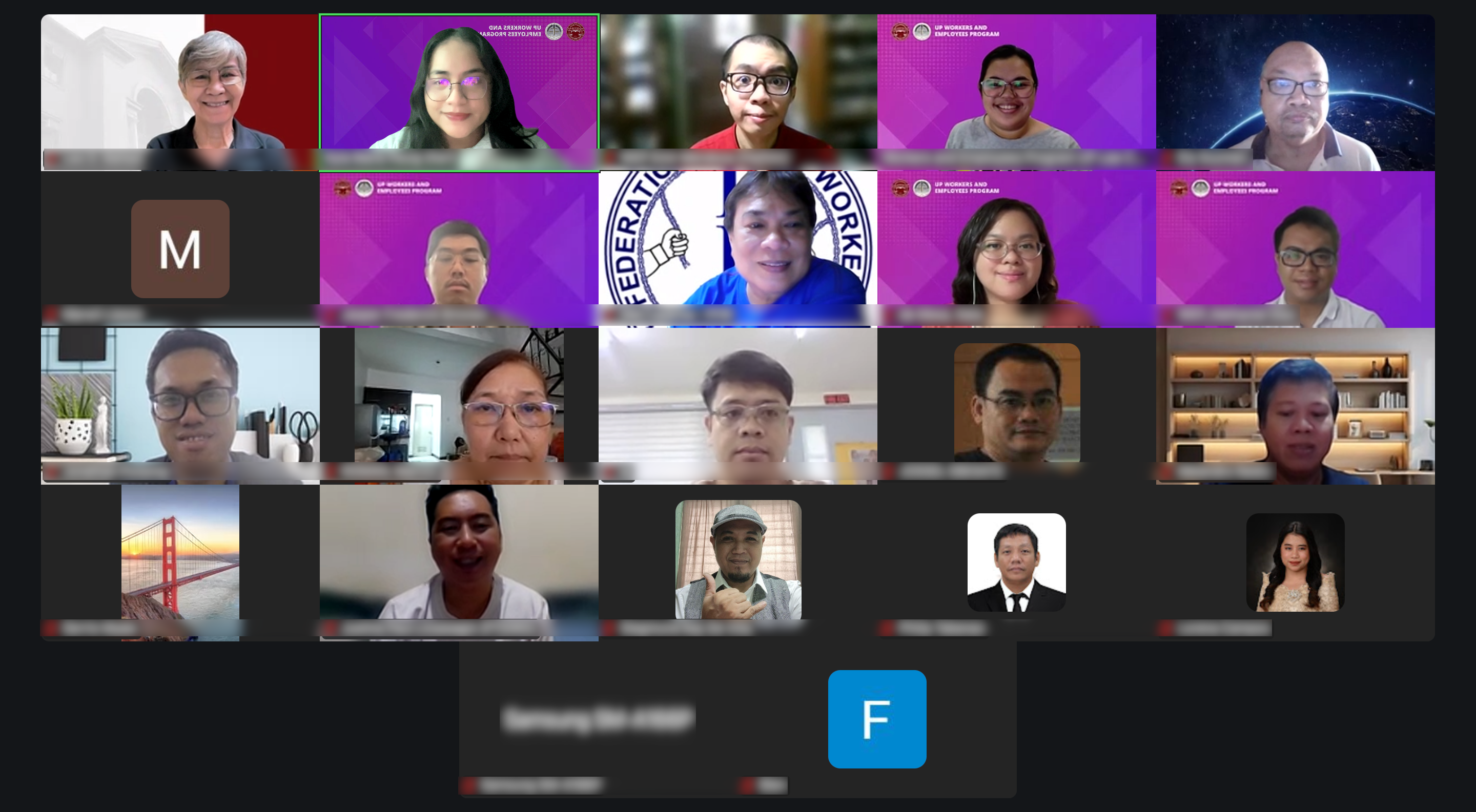
With the Strengthening the Freedom of Association of Workers’ Act unable to become law by the end of the 19th Congress, WEP held two RTDs on 7 and 14 June 2025 to improve said bill for re-filing in the 20th Congress.
To give life to the constitutional right to freedom of association under Article III, Section 8 of the Constitution and the right of workers to self-organization under Article XIII, Section 3, the 14 labor organizations proposed the following amendments:
- Retitle the bill to “Strengthening of Workers’ Right to Self-Organization Act”
- Replace the declaration of policy with Joint Memorandum Order No. 1, Series of 2024 – Omnibus Guidelines on the Exercise of Freedom of Association and Civil Liberties
- Include references to international law such as International Labour Organization (ILO) Conventions No. 87 and 98, the International Covenant on Civil and Political Rights, and the International Covenant on Economic, Social, and Cultural Rights
- Cover public sector workers
- Cover all workers, considering ILO’s definition of a trade union – “A trade union is defined as a workers’ organization constituted for the purpose of furthering and defending the interests of workers “
- Adopt the definition of “harassment” from Joint Memorandum Order No. 1, Series of 2024 – Omnibus Guidelines on the Exercise of Freedom of Association and Civil Liberties
- Adopt the Supreme Court’s definition of “red-tagging”
- Prohibit the act of facilitating seminars that encourage or dissuade union membership
- Prohibit the spread of fake news and disinformation against workers, trade unions, and labor organizations
- Prohibit interference of the National Task Force to End Local Communist Armed Conflict (NTF-ELCAC) in all phases of CBA negotiations
- Prohibit the collection of personal data of workers, their families, and any other person, as defined under Republic Act No. 10173 or the Data Privacy Act
- Institutionalize the Inter-Agency Committee for the Protection of the Freedom of Association and Right to Organize of Workers, formed under Executive Order No. 23 (2023), but exclude the national security agencies and include representatives from the labor and employer sectors
- Include labor law and labor rights education in senior high school
- Require attendees of labor rights education or trainings to be:
- From the executive level of the employer, or at the very least a manager
- At the Undersecretary, Assistant Secretary, or Director level for government agency
- Uphold the right of unions to access employers’ financial statements for purposes of collective bargaining under Article 251 of the Labor Code, instead of it being prejudiced by invoking the Data Privacy Act
Workers with Special Concerns
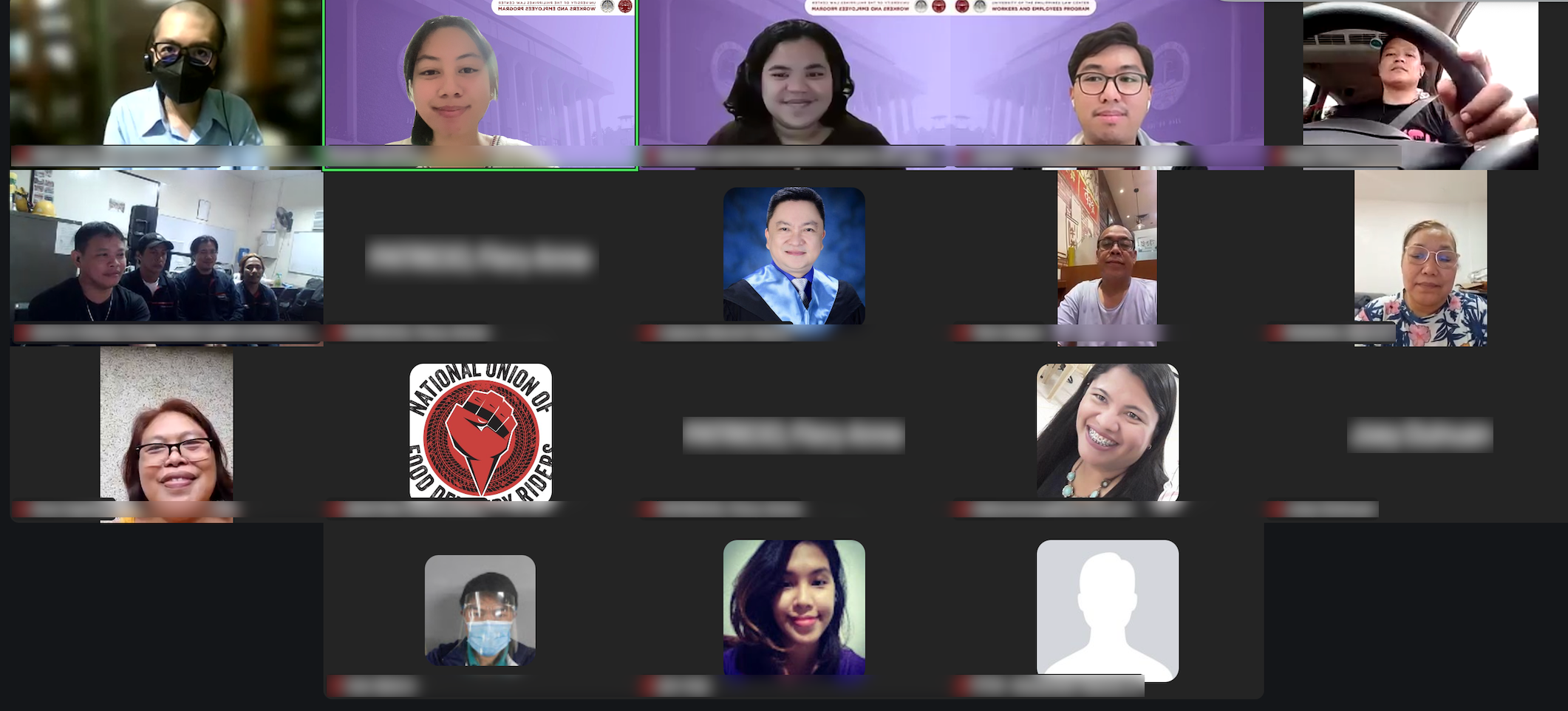
Unlike previous RTDs, which focused on all workers, the 6 September 2025 RTD served as a venue to address concerns affecting delivery riders, virtual assistants, construction workers, workers in the informal economy, education workers, domestic workers (kasambahay), electronic workers, and specific concerns.
17 participants from 10 labor organizations raised the challenges listed below. WEP also shared proposed legislation and asked participants to assess whether these would address their concerns.
- Delivery Riders
- They are not considered as employees
- Multinational companies were not mandated to provide labor standards
- There is no due process in suspension and termination
- Minimum of 2 days’ suspension
- Back wages for the period of suspension not paid
- A rider died of a stroke, account was closed by the platform, and the family could not process the insurance
- Pending cases in labor tribunals and appellate courts to declare as regular employees
- Prone to underpayment
- Must work up to 15 hours a day just to bring home earnings (upang may maiuwi)
- Vulnerable to accidents, no insurance provided
- Quota insurance — for example 300 rides required before qualifying
- Families do not have a copy of the insurance policy and therefore cannot file claims
- When insurance is available, it does not cover damage to motorcycle, gears, bags, or uniform
- Proposal
- If declared employees, the Labor Code applies
- If not, push for guaranteed income, job security, and social protection (insurance, Social Security System, PhilHealth)
- They are not considered as employees
- Virtual Assistants
-
-
- Required benefits are not provided (Bawal na hindi ibinigay)
- Unpaid overtime work and holiday pay (because Philippine holidays are not observed by clients from other countries)
-
-
- 14th Month pay
- Construction Workers
- Project employees working for five years denied regular status
- Employees who filed cases in the National Labor Relations Commission only received 13th month pay
- Another group of employees, declared regular by the Labor Arbiter after filing for illegal dismissal, were made to sign project employment contracts as a condition for reinstatement while awaiting appeal.
- Workplace accidents and lack of employer accountability
- A worker from an electric distribution company was electrocuted
- The employer did not pay any compensation; hospital bills reached PHP 3 million
- Project employees working for five years denied regular status
- Informal Sector
- A local government unit (LGU) owns the transport terminal.
- LGU issued a memorandum evicting vendors in the terminal.
- No law exists to protect vendors in such situations
- Education
- Raise salaries, reduce workload of private sector teachers, and shorten probationary periods to prevent brain drain to public schools
- Advocate for employer-schools to shoulder the cost of Continuing Professional Development (CPD) trainings
- In some schools, no collective bargaining exists
- In one school in Metro Manila, the union is reportedly company-dominated (parang dummy lang ng management ang kanilang union officers)
- Many part-time teachers, even if they teach every semester. Regular teachers are decreasing in tertiary education.
- Probationary Period and Discrimination
- A worker was terminated 3 days before becoming regular due to pregnancy and inability to perform work
- Kasambahay
- Insufficient food, wages, and access to social legislation benefits (SSS, PhilHealth)
- Advocate for Technical Education and Skills Development Authority (TESDA) training programs to help kasambahays adapt to automation and artificial intelligence
- Victims of scams and blackmail
- Also experience physical and economic abuse
- Need for accessible channels to contact employers, the Department of Labor and Employment (DOLE), and the Department of Social Welfare and Development (one-stop shop)
- Fear of filing complaints due to risk of job loss
- Electronics Sector
- A worker assigned to quality inspection was suspended for union activities
- No one assisted the worker during the investigation
- Upon returning to work, the employer reassigned the worker as an operator
- Issue was not resolved through the grievance machinery
- The worker was eventually barred from returning to work.
- Legal Representation and Labor Proceedings
- A worker-complainant in an illegal dismissal case could not submit a position paper on the scheduled date due to the lawyer’s full calendar
- The lawyer filed a motion for extension of time
- The Labor Arbiter became upset
- The Employer was able to submit on time




















































 on the upper right corner to select a video.