
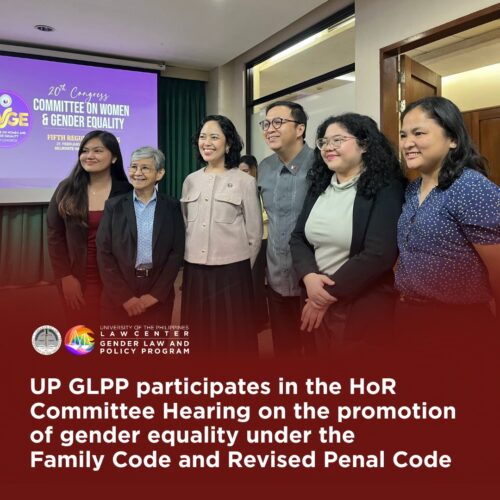
The Family Code of the Philippines has significantly abrogated inequality between the husband and wife. It reformed family law and emancipated the wife from the exclusive control of the husband and placed her at parity with him in the family.¹ However, trails of inequality and partiality to the husband in some of the provisions of the Code have remained.
For decades, provisions that give the husband’s decision “legal primacy” in disagreements over community property or parental authority have treated women as subordinate partners in their own homes. These laws suggest that for a family to function, a woman’s voice must ultimately be subordinate.
This Women’s Month, we declare that a proper family dynamic cannot be built on a foundation of inequality.
Last 25 February 2026, UP GLPP, represented by Prof. Leo D. Battad, Prof. Neil Borja, Atty. Irene Pua, Atty. Aubrey Mejia, and Shane Sison, participated in a Committee Hearing at the House of Representatives regarding proposed amendments to the Family Code (FC) and Revised Penal Code (RPC). The amendments aim to ensure the fundamental equality between men and women under the laws on marriage and family relations through repeal or amendment of discriminatory provisions against women.
UP GLPP expressed its support for the revisions that abolish the legal primacy of one’s parental authority over the other. Additionally, the Program shared its position favoring the total repeal of the laws on adultery and concubinage.
As we observe National Women’s Month, we urge our legislators that the preservation of the family should never come at the cost of a woman’s dignity or agency and that we must seek a balance that does not compromise on human rights, but one that aligns with the constitutional mandate of fundamental equality between men and women.
¹ Romualdez-Marcos v. Commission on Elections, G.R. No. 119976, 248 SCRA 300, Sept. 18, 1995. (Puno, concurring, quoting the late Justice J.B.L. Reyes)

























































 on the upper right corner to select a video.