
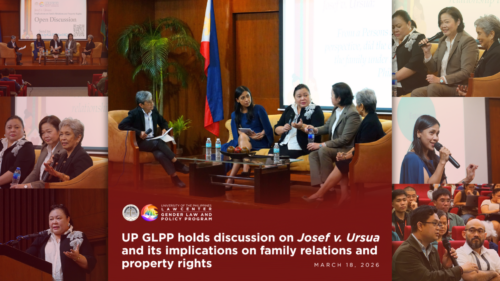
On 05 February 2026, the Supreme Court promulgated its ruling in Josef v. Ursua, recognizing cohabitations of same-sex couples under the Family Code and citing Article 148 of the same as the applicable rule governing their property relations. However, at the same time, the Court acknowledged that the broader applicability of the Family Code to same-sex relationships remains uncertain, given that Philippine law does not recognize same-sex marriage. Thus, the decision invites a thorough examination of its implications on the current legal framework on family relations and property rights for LGBTQIA+ couples.
In response, on 18 March 2026, the UP Law Center Gender Law and Policy Program (UP GLPP) held a discussion titled “Josef v. Ursua: Implications on Family Relations and Property Rights” at the Malcolm Theater, Malcolm Hall, UP Diliman, Quezon City. The event gathered more than 260 participants, which consisted of legal experts from the UP Law faculty, law students from various institutions, and representatives from civic society organizations advocating for gender equality.
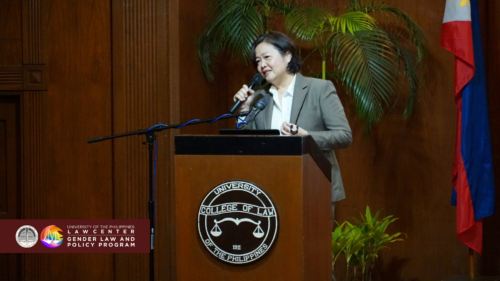
The program started with a welcome message from Dean Gwen Grecia-De Vera, who underscored the significance of Josef v. Ursua as a shield for property rights and a call for the ongoing necessity of legislative evolution to secure full equality. Atty. Aubrey Mejia, UP GLPP Senior Legal Associate, then provided a case overview on the Supreme Court ruling.
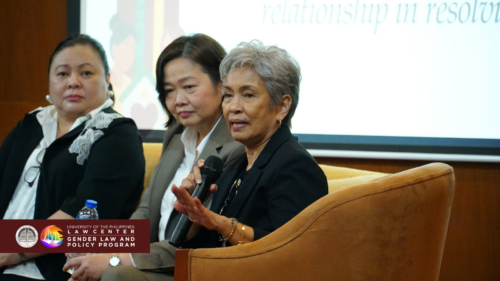
The forum featured a distinguished panel of speakers who examined the ruling from different legal perspectives. From the standpoint of Persons and Family Law, Prof. Elizabeth H. Aguiling-Pangalangan, Philippine Representative for Children’s Rights to the ASEAN Commission on the Promotion and Protection of the Rights of Women and Children (ACWC) and Head of the Children’s Rights Program of the UP Institute of Human Rights (UP IHR), shared her insights. She noted the rights and obligations that can be extended to same-sex couples under the present framework, as well as those that cannot be applied without amendments to existing laws.
On the other hand, Atty. Mia G. Gentugaya, senior lecturer on Property and Obligations & Contracts at UP Law, expounded on the matter of property rights as addressed in the case. She highlighted that there remain other aspects yet to be clarified, such as on implementing partition among same-sex couples.
Offering a perspective from succession law, Atty. Froilyn P. Doyaoen-Pagayatan, senior lecturer on Succession and Private International Law at UP Law, presented illustrations and analysis on the interplay of successional rights affecting LGBTQIA+ couples and families.
Lastly, addressing the ruling’s impact on Marriage Equality Advocacy, Atty. Virginia B. Viray, senior lecturer at UP Law and Advocate of the Year awardee in the Asian Legal Business – Women in Law Awards, highlighted that although the case of Josef v. Ursua represents a shift in the view on intimate relationships and cohabitation under the Family Code, the journey to true visibility and equality remains ongoing. Atty. Viray further emphasized the apparent disparity in the enforcement and protection of rights of LGBTQIA+ couples, who are often subjected to additional legal requirements and a stricter level of standards—such as in this case, proving actual contribution in asserting property rights after cohabitation—which would not be ordinarily imposed on heterosexual couples, except in exceptional circumstances.
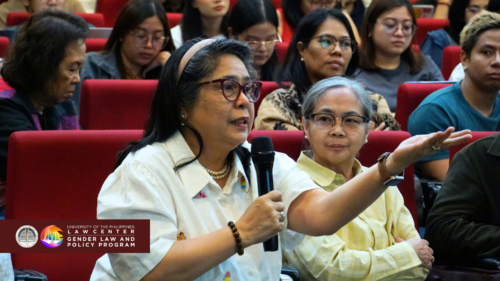
The panel presentations were followed by an open discussion moderated by Prof. E. (Leo) D. Battad, UP GLPP Program Director. Members of the UP Law faculty and participants actively engaged with the speakers, raising questions centered on possible directions for advocacy and policy reform in light of the ruling, reflecting both the opportunities and limitations the ruling presents.
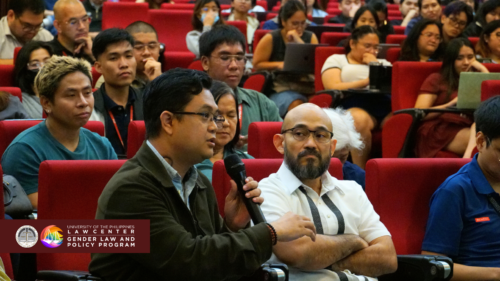
Overall, the discussion emphasized that while Josef v. Ursua marks a significant step toward the recognition of same-sex relationships, existing laws continue to fall short of affording equal protection to LGBTQIA+ individuals, couples, and families. Many rights remain inaccessible under the current legal framework. In the absence of marriage equality, LGBTQIA+ families remain outside the full protection of the law, perpetuating marginalization and vulnerability of the LGBTQIA+ community.
On this note, the UP GLPP remains steadfast in its commitment to advancing responsive and evidence-based legislative initiatives aimed at addressing legal gaps in the protection of LGBTQIA+ couples’ and individuals’ rights and in promoting marriage equality.


































 on the upper right corner to select a video.