
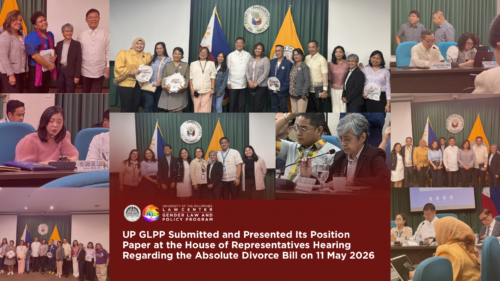
On 11 May 2026, the UP Gender Law and Policy Program attended the initial deliberations on the proposed Absolute Divorce bills at the Committee on Population and Family Relations of the House of Representatives.
The hearing brought together legislators and stakeholders to discuss the necessity of providing Filipinos with a “second chance” at dignity and peace through the dissolution of irreparable marriages.
Bill authors, including Rep. Sarah Elago and Rep. Cielo Krisel Lagman, emphasized that divorce should not be “just for the rich” and that it is not mandatory, but rather an option for those in dysfunctional marriages. Legislators and resource persons in favor of divorce highlighted provisions such as a cap on attorney’s fees, support for indigent litigants, and prioritization of Overseas Filipino Workers (OFWs).
Advocates also noted that 15.5% of Filipinos experience intimate partner abuse, asserting that divorce offers a vital means of escape from toxic environments. Discussions also covered the inclusion of indigenous customary laws and the existing Code of Muslim Personal Laws as precedents for equality in divorce rights.
To prevent “notarial” or “express” divorce, which would remain prohibited under the bills, the proposed measures include varying mandatory cooling-off periods (except in cases of violence) and stringent judicial processes.
The UP GLPP, represented by its Program Director, Prof. Leo D. Battad, expressed its strong support for the passage of Divorce. Citing international human rights instruments to which the Philippines is a party, the UP GLPP maintained that it is the State’s mandate to cater to the “protection of the fundamental human rights and dignity of persons trapped in failed and irreparable marriages.”
The UP GLPP also proposed further revisions to the pending bills, such as the inclusion of international human rights principles in the declared policy and providing OFWs with the option to attend hearings online, among others.
Religious groups have also raised concerns, citing studies on the potential negative effects of divorce on families, women, and children.
As the Philippines remains the last country in the world (alongside Vatican City) without a divorce law, the push for this legal remedy continues. The UP GLPP remains committed to providing gender-responsive legal analysis on the legal and social effects of divorce as the bills move forward to the Technical Working Group (TWG).

























 on the upper right corner to select a video.